
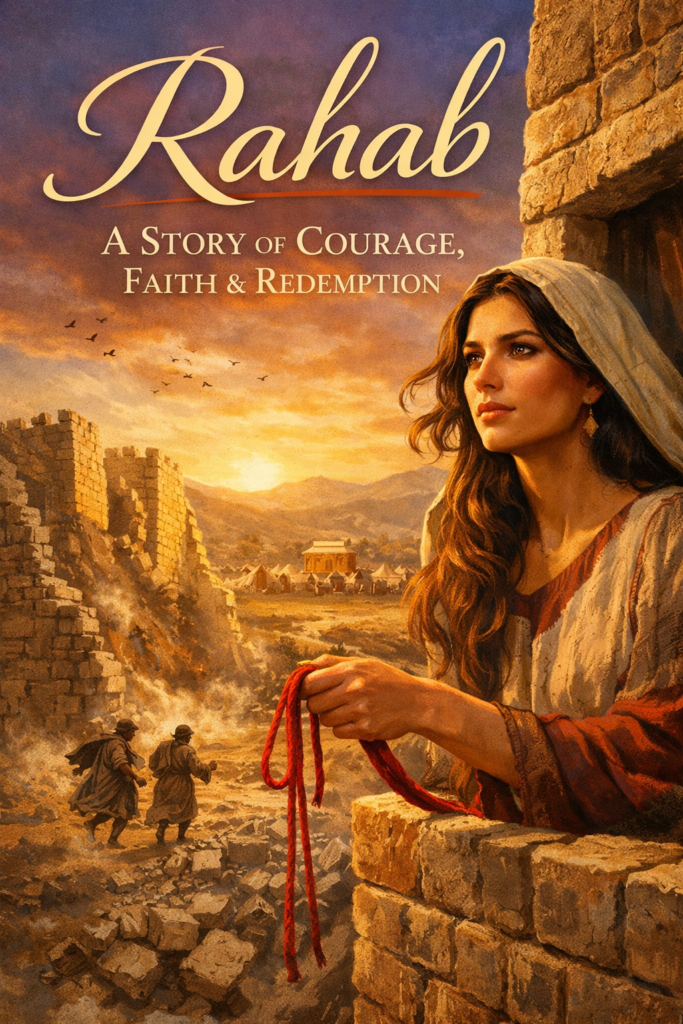
Rahab: A Story of Courage, Faith, and Redemption
When we open the book of Joshua, we meet a woman whose story stands out like a bright thread woven into the tapestry of Scripture. Rahab—a Canaanite, a prostitute, a woman living on the margins—becomes one of the most powerful examples of courageous faith in the entire Bible. Her story reminds us that God delights in using unlikely women to accomplish extraordinary things.
Rahab in Scripture: The Facts of Her Story
Rahab’s story unfolds in Joshua 2 and Joshua 6, with her legacy echoed in Matthew 1:5, Hebrews 11:31, and James 2:25.
Israel is preparing to enter the Promised Land, and Jericho is the first obstacle standing in their way. Joshua sends two spies into the city, and they end up at Rahab’s house—likely because her home, built into the city wall, offered both privacy and an escape route. When the king’s men come searching for the spies, Rahab hides them on her roof and sends the soldiers in the wrong direction. She risks everything—her life, her livelihood, her safety.
Why would she do this?
Rahab explains that she has heard what God has done for Israel: the Red Sea parting, the victories over powerful kings, the miracles that proved God’s power. She tells the spies that the people of Jericho are terrified because they know Israel’s God is real. Then she makes a bold confession of faith:
“The LORD your God, He is God in heaven above and on the earth beneath.” (Joshua 2:11)
Rahab believed before she ever saw.
The Crimson Cord: A Sign of Salvation
Before the spies leave, they make a covenant with Rahab. Because she protected them, they promise to protect her when Israel attacks Jericho. But there is one condition: She must tie a crimson cord in her window—the same window she used to lower the spies to safety (Joshua 2:18).
This scarlet cord becomes:
- A sign of her faith
- A symbol of protection
- A marker of covenant loyalty
- A picture of redemption
When the walls of Jericho collapse in Joshua 6, Rahab’s home—marked by the crimson cord—stands untouched. She and her family are rescued and brought safely into Israel. Many Bible teachers see this scarlet cord as a foreshadowing of Christ’s sacrifice. Just as the blood of the Passover lamb protected Israel in Egypt, the crimson cord marked Rahab’s household for salvation.
It is a reminder that God saves those who trust in Him, no matter their past.
Rahab’s Bravery: Courage in the Face of Danger
Rahab’s courage wasn’t loud or dramatic—it was steady, costly, and rooted in faith.
She risked:
- Her life, by hiding the spies
- Her reputation, by aligning with Israel
- Her future, by turning away from her culture’s gods
Courage is not the absence of fear. Courage is choosing faith in the middle of fear. Rahab acted because she believed God was who He said He was. Her bravery saved her entire family.
Rahab’s Faith: Believing Before Seeing
Rahab’s faith is remarkable because it came from hearing, not witnessing.
She had:
- No miracles performed in front of her
- No prophet speaking to her
- No Scripture scrolls
- No community of believers
Yet she believed.
This is why Rahab is honored in the Hall of Faith in Hebrews 11 and why James uses her as an example of faith that produces action. Rahab teaches us that faith begins with a heart that responds to God—even when we don’t have all the details.
Lessons We Learn from Rahab’s Story
Rahab’s story speaks powerfully to women in every season of life. Here are truths we can hold onto:
1. Your past does not disqualify you from God’s purpose.
Rahab’s identity in Jericho did not define her destiny in God’s kingdom. God specializes in rewriting stories.
2. God sees value where others see labels.
Rahab was known by her profession, but God saw her potential. He sees beyond our mistakes, our history, and our insecurities.
3. Faith grows when we listen to what God has done.
Rahab believed because she heard testimonies. Your faith can grow the same way—through Scripture, through stories of God’s faithfulness, and through the encouragement of other women. Your testimony is a powerful tool, Use it to encourage yourself and others around you.
“And they overcame him by the blood of the Lamb, and by the word of their testimony; and they loved not their lives unto death.” Revelation 12:11
4. Courage is choosing God even when it costs you something.
Rahab risked everything to align herself with God. Sometimes obedience requires stepping out of comfort and into trust.
5. God can use one woman’s faith to change generations.
Rahab became the mother of Boaz, the great‑grandmother of King David, and part of the lineage of Jesus (Matthew 1:5). Her faith didn’t just save her family—it shaped history. Decisions we make daily not only affect us, but others around us.
Final Thoughts
Rahab’s story is a beautiful reminder that God delights in redeeming, restoring, and repurposing lives. She began as an outsider, but through faith, she became part of God’s family and part of His redemptive plan. Her courage challenges us. Her faith inspires us. Her redemption gives us hope. May we be women who, like Rahab, choose to believe God’s promises, act with courage, and trust Him to rewrite our stories for His glory.
Your new story can start today!
Great devotion! And very Timely. I’m trying to move Jennifer out of the way and just believe God’s promises and hang on for dear life for my total healing.