
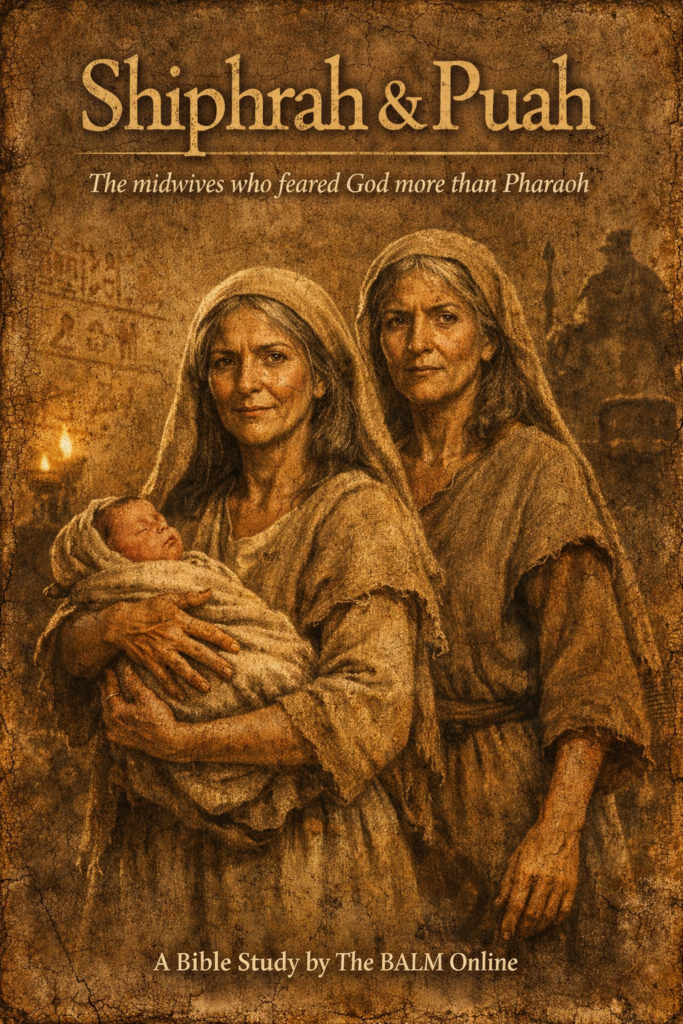
Shiphrah & Puah
The Midwives that Feared God more than Pharaoh
Exodus 1:15-21
The cries of newborn babies echoed through the land of Egypt, but so did the cries of oppression. The Israelites had grown in number, and Pharaoh — threatened by their strength — tightened his grip. He enslaved them, beat them, and forced them into brutal labor. Yet the more he oppressed them, the more they multiplied. Fear twisted Pharaoh’s heart into something darker, something deadly.
So he devised a plan.
He summoned two Hebrew midwives — Shiphrah and Puah — women who had delivered countless babies, women whose hands had caught life as it entered the world. They were respected, trusted, and known among the Hebrew families. Pharaoh looked them in the eyes and issued a command that froze the air around them:
“When you help the Hebrew women give birth, if it is a son, kill him. If it is a daughter, let her live.”
It was a death sentence disguised as an order. A command to turn their sacred calling into an act of violence. A demand that they betray the very people they served. Shiphrah and Puah left Pharaoh’s presence with the weight of his words pressing on their chests. They knew the cost of disobedience. Pharaoh was not a man to be challenged. His word was law. His anger was lethal. And yet… so was his command.
But these women feared God more than they feared Pharaoh.
So when the Hebrew women went into labor, Shiphrah and Puah did what they had always done. They knelt beside them. They whispered encouragement. They caught the babies as they entered the world — boys and girls alike. They wrapped them, cleaned them, and placed them in their mothers’ arms.
They protected life in the face of death.
Word spread quietly among the Hebrew families: “The midwives are still delivering our sons.” “They are not obeying Pharaoh.” “They are risking everything for us.”
But eventually, word reached Pharaoh too.
He summoned them again, fury burning in his eyes. “Why have you done this?” he demanded. “Why have you let the boys live?” Shiphrah and Puah stood before the most powerful man in the world — two women with no army, no status, no protection. Yet they answered with wisdom and courage:
“The Hebrew women are strong. They give birth before we arrive.”
It was a bold answer — part truth, part strategy — and God honored it. Scripture says, “God dealt well with the midwives.” He blessed their households. He strengthened their influence. He multiplied the people they protected. And because Shiphrah and Puah refused to bow to fear, a generation of Hebrew boys lived — including one baby who would one day float down the Nile in a basket… a baby named Moses, Their courage preserved the deliverer before he ever drew his first breath.
Shiphrah and Puah never parted the Red Sea. They never confronted Pharaoh. They never stood on a mountain with tablets of stone. But without them, Moses would not have lived long enough to do any of those things. They were the quiet heroes of Exodus — women who stood between life and death, between oppression and deliverance, between a tyrant’s command and God’s promise.
Two midwives. Two ordinary women. Two world‑changers.
✨ What We Can Learn from Shiphrah & Puah
Shiphrah and Puah teach us that courage doesn’t always roar. Sometimes it whispers “no” when everyone else is saying “yes.” Sometimes it shows up in the small, hidden places — in decisions no one sees, in moments no one applauds, in choices that feel costly but holy.
Their story teaches us:
1. You don’t need a title to make an impact.
They weren’t queens, prophets, or warriors. They were midwives — ordinary women with extraordinary conviction. God used their everyday work to shape history.
2. Fear of God frees you from fear of people.
Pharaoh was terrifying. But God was greater. Their reverence for God gave them the courage to resist evil.
3. Protecting the vulnerable is sacred work.
They stood between innocent lives and a violent system. Women today are still called to stand in the gap — for children, for the oppressed, for the overlooked, for the silenced.
4. Quiet obedience can have generational impact.
They didn’t know Moses would become Israel’s deliverer. They didn’t know their courage would echo through Scripture. They simply did what was right — and God used it to change the world.
5. God sees the women who stand in the shadows.
Their names are recorded in Scripture — a rare honor. God made sure the world would never forget them.
🔥 Conclusion
Stand for what is right
Even when it’s risky,
Even when it’s quiet,
Even when no one is watching.
Protect what God has placed in your hands.
Defend the vulnerable.
Choose courage over comfort.
Choose obedience over fear.
Choose God’s voice over the world’s pressure.
Like Shiphrah and Puah, your faithfulness may preserve a destiny you cannot yet see.
This was great… I hope God sees me as faithful.
This is a great study!! I always love reading it. It shows me personally that if you fear God he will increase, provide, and protect you. We do not know what would have happened if they did not do the right thing but the one thing we do know is that they obeyed God not man. They feared God not man and it is a powerful story to show what the fear of God in our lives will do and the destiny behind it. Amen! Thank you for this powerful reminder.