
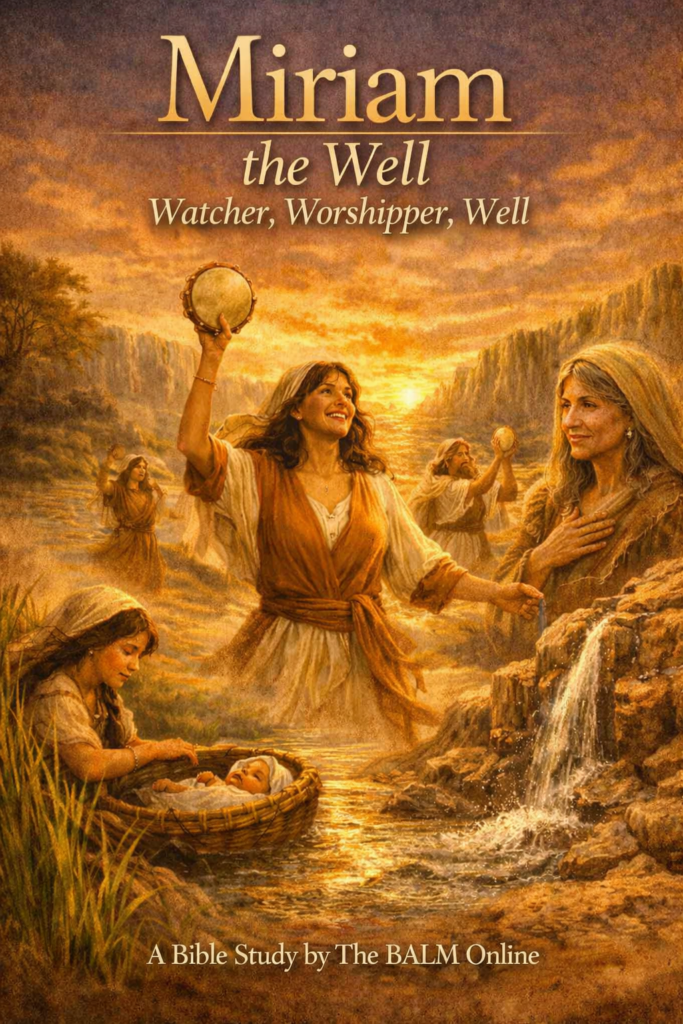
Miriam the Well
Numbers 20:1–2 • Exodus 15:22–27 • 1 Corinthians 10:1–4
Over the past three weeks, we’ve followed Miriam through the defining seasons of her life. We met Miriam the Watcher, the courageous young girl who protected baby Moses at the Nile. Then we celebrated with Miriam the Worshipper, the prophetess who led Israel in praise after crossing the Red Sea. Last week, we sat with Miriam the Beloved, the woman whose community loved her so deeply that they waited for her restoration.
Now we arrive at the final chapter — quiet, brief, but profoundly revealing. This is Miriam the Well, the woman whose love, compassion, faithfulness, and worship kept Israel connected to the true Source of their provision: God Himself.
Numbers 20 begins with a simple, somber statement:
“Miriam died and was buried there.” (Numbers 20:1)
Immediately — without transition, without pause — Scripture says:
“Now there was no water for the congregation…” (Numbers 20:2)
For forty years, Israel wandered through the wilderness. For forty years, they faced hunger, heat, enemies, and uncertainty. But they never complained about water — not once — until Miriam died.
This sudden thirst is not a coincidence.
Jewish Tradition: Miriam’s Well
Jewish tradition teaches that a miraculous well, known as Miriam’s Well, followed Israel throughout the wilderness. Wherever they camped, water flowed. When Miriam died, the well dried up, and the people felt the loss immediately. But here’s the deeper truth:
Miriam Was the Well
Not because she produced water — but because her love, her compassion, her faithfulness, and above all her worship kept Israel connected to God, the true Source of their provision. Her presence reminded the people who God was. Her worship kept their hearts aligned with Him. Her leadership kept them spiritually hydrated. Her faith kept them connected to the Rock. When Miriam died, the people didn’t just lose a woman — they lost a connection point to God’s presence.
In the New Testament, Paul writes:
“They drank from the spiritual rock that followed them, and that rock was Christ.” (1 Corinthians 10:4)
Paul confirms that a source of water followed Israel — and that source was Christ, the true Rock. Jewish tradition calls it Miriam’s Well. Paul calls it Christ the Rock. Together they reveal this truth: Jesus is the source, the provider, the living water. They needed it way back then and we need it even more now.
Miriam’s life was a vessel through which God’s provision flowed. Her worship kept Israel connected to Christ, the Living Water.
What We Learn from Miriam‘s Story
1. God can use you at every stage of life.
Miriam was a child when God used her to protect Moses (Exodus 2). She was a grown woman when she led worship at the Red Sea (Exodus 15). She was a seasoned leader when she walked through the wilderness (Numbers 12–20).
Your age does not limit your assignment. God uses girls, women, elders — every season carries purpose.
2. Worship is not just a song — it is a source.
When Miriam lifted her tambourine, she didn’t just sing — she opened a well of joy, courage, and remembrance for the entire nation. Her worship refreshed Israel. Her praise strengthened weary hearts. Her leadership helped a traumatized people breathe again. When she died, the water dried up (Numbers 20:1–2). This was not coincidence — it was symbolism. Her worship had been a spiritual well in the wilderness. Your worship can do the same. It can nourish your home, your church, your children, your community.
3. Comparison and Pride is a silent killer of calling.
Miriam’s downfall began with a question rooted in comparison:
“Has the Lord indeed spoken only through Moses?” (Numbers 12:2)
Comparison turns sisters into rivals. It turns calling into competition. It turns worship into resentment. Comparison is not harmless — it is corrosive. It blinds us to our own assignment and poisons our view of others. Miriam wasn’t wrong that God had spoken through her. She was wrong in assuming that made her equal to Moses’ assignment. Spiritual pride whispers: “I deserve more.” “I’m just as important.” But God opposes pride — even in His daughters. He corrected Miriam not to shame her, but to save her.
4. Speaking against God’s leaders is speaking against God Himself.
Miriam and Aaron thought they were criticizing Moses. But God said, “Why were you not afraid to speak against My servant?” (Numbers 12:8) God defends His leaders. He hears every word spoken in secret. He takes dishonor seriously. This is a warning — and a mercy. God corrects us because He wants to keep us aligned with His heart.
5. Correction is painful — but it is also proof of God’s love.
Miriam’s leprosy was public. Her shame was visible. Her separation was humiliating. But it was also healing. God did not remove her calling, the water did not stop flowing — He restored her heart. And the people waited for her (Numbers 12:15). They refused to move without her.
This is what grace looks like: Correction that leads to restoration. Discipline that leads to dignity.
6. Wells Are Not the Source — They Are the Conduit
Miriam didn’t produce water. She pointed people to the One who did. We are not the answer — but we can lead people to the Answer. Just like Miriam, your quiet faithfulness may be keeping someone connected to God. Your worship may be refreshing someone’s spirit. Your compassion may be keeping someone from drying out.
7. When a Well Stops Flowing, People Become Thirsty
Israel’s thirst revealed how deeply Miriam’s presence mattered. Sometimes God allows thirst to show us what we’ve lost — or what we need to return to. Who might be depending on you for a connection to the source?
8. Christ Is the True Well That Follows Us
Miriam’s well was a shadow of the greater well — Jesus, the Living Water. He is the Source. We are the vessels. He follows us. He will never leave us or forsake us. He provides living water that will never run dry. What are you doing with your water?
Conclusion
Miriam’s life teaches us that people are thirsty — thirsty for hope, thirsty for encouragement, thirsty for truth, thirsty for God. And just like Israel, people today are searching for a source, a connection, a provision.
You can be that well.
Not because you are the source — but because your love, your compassion, your faithfulness, and your worship can lead people to the true Source: God.
- Be a well of encouragement.
- Be a well of compassion.
- Be a well of prayer.
- Be a well of worship.
- Be a well that connects thirsty people to God.
Let your life be a vessel through which the Living Water flows. Just as Miriam sustained Israel,
You can refresh someone’s journey today.
What a befitting end to the “Miriam trilogy”. I’m sad that it is ending. Thank you for making Miriam come alive to me instead of just a name and a story in the Bible. She’s real! I want to be real! I want to be that well, I’ve got to keep it full, so I can impart it to others. Loved, loved, loved, loved it. I know the next one will be just as good but I think I want to wallow in this one for a little bit.💦
Amen! What a blessing it has been to dive deeper into Miriams example for us. May we allow God to flow through us daily and may we heed the warning of pride and arrogance in comparison. Let us not be ignorant to the truth of God and his word, Amen! Thank you for this powerful study. It has definitely been encouraging for me and I pray it is for all who reads it!