
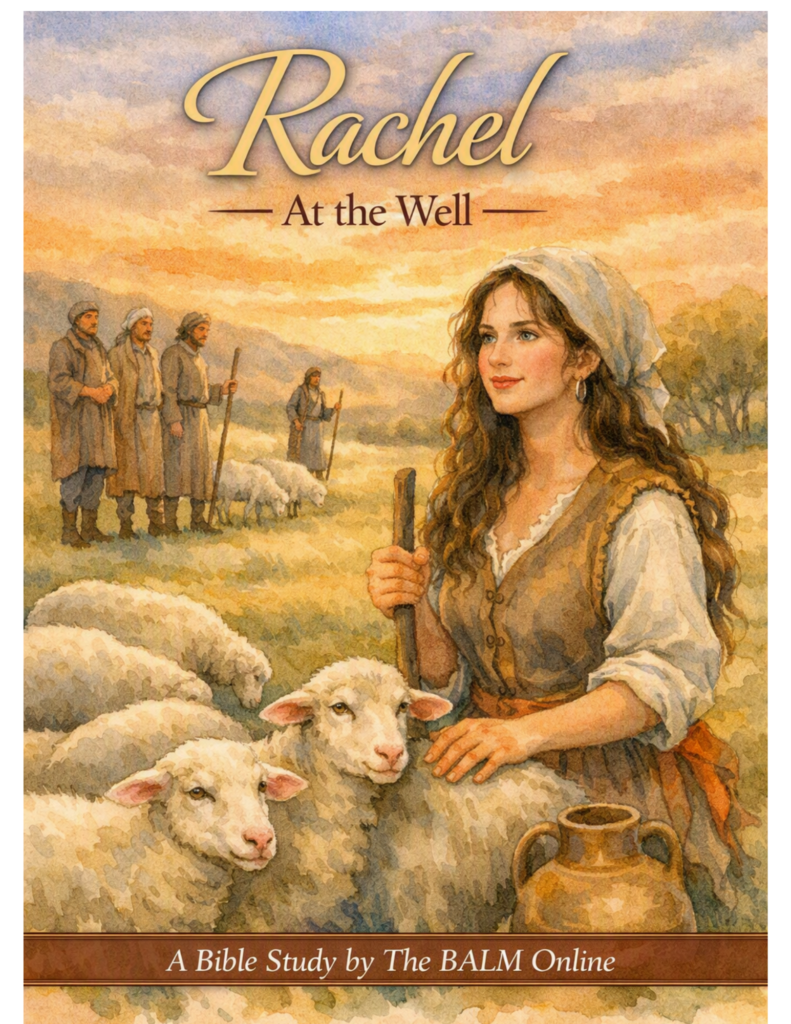
Rachel
At the Well
Genesis 29
Water is one of Scripture’s most powerful symbols—representing life, renewal, calling, and divine encounter. Again and again, God meets His people beside wells, rivers, and springs. In our recent studies, we’ve noticed a surprising pattern: many of the most influential women in the Bible have stories shaped by water.
Rebekah was found at a well, where her kindness revealed God’s choice for Isaac’s wife. Miriam watched over Moses at the Nile and later became associated with the miraculous “Miriam’s Well” in Jewish tradition. Shiphrah and Puah courageously saved Israelite babies from being thrown into the river. Moses met Zipporah at a well in Midian, where hospitality and protection opened the door to his future family. Today, we continue this water‑themed journey by studying Rachel, the woman Jacob met at a well—a moment that would shape the future of the twelve tribes of Israel.
Jacob arrived in Haran weary and emotionally drained. He had fled from his brother Esau after deceiving him and stealing the blessing (Genesis 27:41–45). Carrying both guilt and hope, Jacob traveled toward the land of his mother’s family, trusting God’s promise spoken to him at Bethel (Genesis 28:13–15). As he approached the outskirts of the city, he saw a well—covered by a large stone—and several shepherds waiting to water their flocks (Genesis 29:2–3). Wells were community hubs, places where daily life intersected with divine timing. Jacob asked the shepherds about their home and family. As they answered, they said, “Here comes Rachel, the daughter of Laban” (Genesis 29:6).
Jacob looked up—and saw her.
Rachel approached with confidence, guiding her father’s sheep with practiced skill. Scripture tells us she was a shepherdess (Genesis 29:9), a role that required strength, attentiveness, and responsibility. Her daily work placed her exactly where God intended Jacob to find her. Moved by purpose and perhaps by love at first sight, Jacob stepped forward. The shepherds had been waiting for enough men to move the heavy stone from the well’s mouth, but Jacob—energized by emotion and divine appointment—rolled the stone away by himself (Genesis 29:10). He then watered Rachel’s flock, serving her before ever introducing himself.
Overwhelmed, Jacob kissed Rachel and wept aloud (Genesis 29:11). His tears were not merely romantic—they were spiritual. Jacob recognized God’s hand. This was no coincidence. This was covenant continuation.
Rachel ran to tell her father, and Jacob was welcomed into their home (Genesis 29:12–14). What began at a well would unfold into years of love, labor, rivalry, blessing, and heartbreak. Rachel’s story is not simple—but it is sacred.
What We Learn from Rachel’s Story
1. God Meets Us in Ordinary Places
Rachel wasn’t praying, sacrificing, or seeking a vision. She was working—doing her daily job as a shepherdess. Yet God placed her at the exact moment Jacob arrived. Your everyday routines may be the very places God is preparing to reveal His direction.
2. Calling Often Begins with Service
Jacob’s first act toward Rachel was service—watering her flock (Genesis 29:10). Love, calling, and covenant frequently begin with humility.
3. The well is where we find Our Direction
When Jacob arrived at the well in Haran, he wasn’t looking for a revelation—he was simply following the path before him (Genesis 29:1–10). Yet at that well, God aligned his steps with his destiny. Rachel’s presence marked the beginning of a new chapter not only for Jacob but for the entire nation of Israel. if you do not know what to do, If you are looking for direction, Go To The Well Jesus
4. Wells Represent Divine Appointments, Not Accidents
Rebekah met Abraham’s servant at a well. Zipporah met Moses at a well. Rachel met Jacob at a well. These encounters shaped nations. The well reminds us that God orchestrates meaningful connections at the right time and place. Your “well moments” may be God‑appointed intersections that change your future.
5. Wells Are Places of Provision After Seasons of Emptiness
Jacob arrived at the well exhausted, alone, and uncertain — yet God met him there with provision, companionship, and a future. God often brings refreshment and direction after seasons of dryness. The well symbolizes the moment God restores what felt lost.
6. Wells Teach Us to Pause Before We Proceed
Jacob didn’t rush past the well — he stopped, asked questions, listened, and waited. Sometimes God’s direction comes when we pause long enough to notice who is approaching, who is waiting, and what God is doing around us. Pause not camp out forever, but take notice of what He is doing around you!
Conclusion
Rachel’s story begins at a well—a place of water, work, and divine appointment. As you reflect on her life, consider your own “well.” Where is God meeting you in the ordinary? Where is He calling you to serve, trust, or surrender? Where is He writing a story that is more than you could think or imagine?
This week,
Pause at your own symbolic well.
Look for God’s presence in your routines.
Offer service where you can.
Trust Him with the complicated parts of your story.
Remember: God often begins His greatest work in the most ordinary places.
Let Rachel’s story inspire you to draw near to the Source of living water—and to step boldly into the calling He is shaping in your life.
All of the well stories have been magnificent… but this one… This one Has really opened up my mind…my understanding. I am pausing…hopefully not camping out🙄…(you know me well)…and going over routines. Thank you very much. I am saving this to be looked at over and over.
I do have to say I love these well stories! They are great to have for examples. For amazing God moments to remember. Im grateful for the well of living water, Jesus. He is who we are able to run to and seek in these days we are in. What a Joy and refreshment of living water he is!