
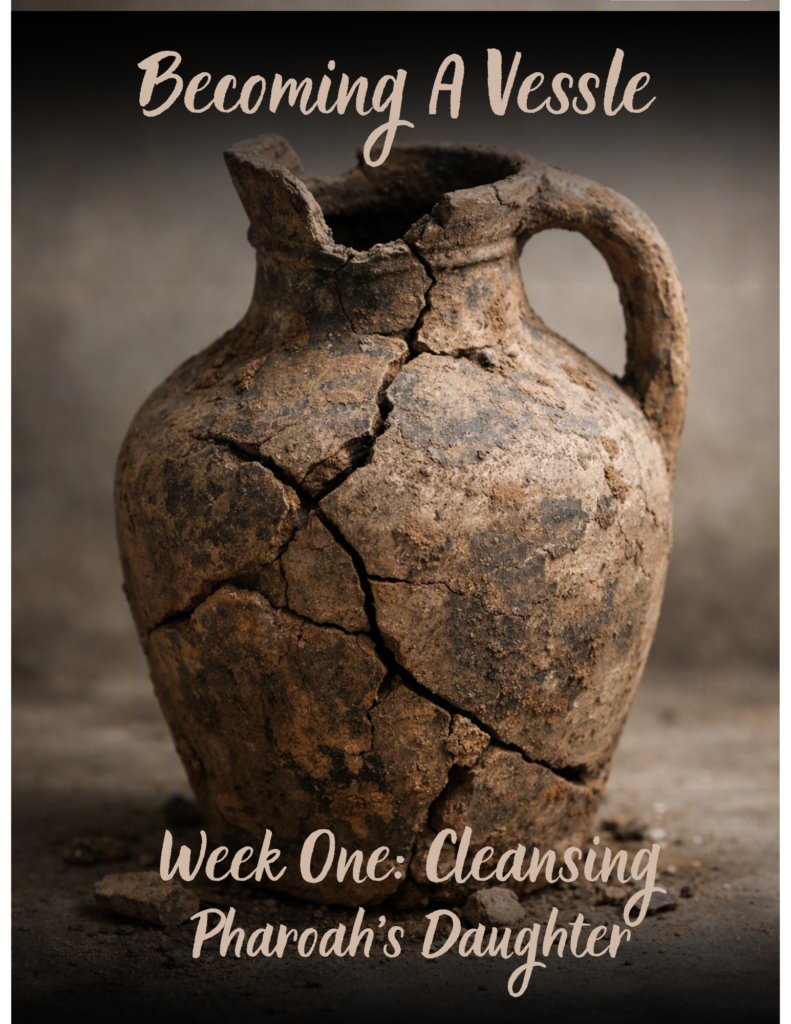
Becoming A Vessel
Week 1: Cleansing
Pharoah’s Daughter
Exodus 2:1–10
Over the last several weeks, we studied women whose lives were changed at the well — women who encountered God in moments of thirst, need, and divine interruption. At the well, they received Living Water: truth, healing, identity, and transformation. But now that we have been to the well… what comes next?
Receiving Living Water is only the beginning. After the well, a woman must become a vessel — someone who can carry what God has poured into her without leaking, cracking, or contaminating it. A vessel is not formed in an instant. It is shaped. It is cleansed. It is prepared.
This new series, Becoming a Vessel, will guide us through the spiritual process of becoming a woman who can carry Living Water with purity, strength, and purpose. And the first step in becoming a vessel is cleansing — repentance, turning, changing direction, and allowing God to remove what cannot remain.
To explore this, we begin with an unexpected woman whose story is tucked quietly into Scripture: Pharaoh’s Daughter.
Pharaoh’s decree was clear and brutal: Every Hebrew baby boy must be thrown into the Nile (Exodus 1:22). This command shaped the atmosphere of Egypt — fear, cruelty, and oppression hung over the land like a dark cloud. Pharaoh’s Daughter grew up in this environment. She was raised in privilege, surrounded by servants, and trained in the customs of Egypt. Yet she lived under the shadow of her father’s violence.
One morning, she went down to the Nile to bathe (Exodus 2:5). The river was a place of ritual cleansing in Egyptian culture, but on that day, it became a place of moral cleansing for her soul. As she walked along the riverbank, she noticed a basket hidden among the reeds. Her attendants retrieved it, and when they opened it, they found a Hebrew baby crying inside (Exodus 2:6). In that moment, Pharaoh’s Daughter faced intense inner turmoil. She knew the law. She knew her father’s expectations. She knew what she was supposed to do. But she also knew what was right. The text says she had compassion on him (Exodus 2:6). Compassion is the first sign of cleansing — the first crack in the hardness of a sinful culture. She stood at a crossroads:
- Follow her father’s command and allow the child to die
- Or take a stand and defy the most powerful man in the world
Change is hard. Turning is costly. Cleansing requires courage.
Pharaoh’s Daughter chose compassion over cruelty. She chose life over death. She chose righteousness over comfort. She chose a different path than the one she was raised in. She rescued the child. She allowed his sister to find a Hebrew nurse (Exodus 2:7–8). She adopted him as her own (Exodus 2:10). She named him Moses, meaning “drawn out of the water.” Her decision changed history. Before Moses could become a deliverer, she had to become a vessel — a woman who turned away from the darkness of her household and toward the light of God’s purposes.
Her cleansing made room for God to use her.
What We Learn From Pharaoh’s Daughter
1. Cleansing begins with a turn.
Repentance is not always about personal sin. Sometimes it is about changing direction, choosing a different way than the one you were taught, raised in, or surrounded by. Pharaoh’s Daughter turned away from:
- her culture’s cruelty
- her father’s violence
- the expectations placed on her
She turned toward compassion, justice, and life.
2. Cleansing requires courage.
Her decision was dangerous. She defied Pharaoh — her own father. Cleansing often requires confronting what is wrong, even when it costs you something.
3. Cleansing is an internal shift before it becomes an external action.
Before she lifted Moses out of the water, she lifted her heart out of Egypt’s darkness. Repentance begins inside — in the unseen places.
4. Cleansing prepares you to carry what God entrusts.
If Pharaoh’s Daughter had not turned, she could not have carried Moses. If we do not turn, we cannot carry Living Water.
5. Cleansing is the first step in becoming a vessel.
Before God fills a woman, He forms her. Before He forms her, He cleanses her. Before He cleanses her, she must choose to turn.
Pharaoh’s Daughter shows us that turning is the doorway to becoming a vessel.
Conclusion
Before you can carry Living Water, you must become a vessel that can hold it. And before you become a vessel, you must be cleansed. Cleansing is not about shame. It is not about punishment. It is not about perfection.
Cleansing is about turning.
Turning away from what contaminates. Turning away from what drains you. Turning away from what God never intended for you to carry. And turning toward:
- compassion
- obedience
- holiness
- purpose
- the God who fills vessels with Living Water
Like Pharaoh’s Daughter, you may be standing between two worlds — the one you’ve known and the one God is calling you into. Becoming a vessel begins with choosing His way. This is your first step after the well. This is where the vessel journey begins. This is where cleansing makes room for Living Water.
This is very stirring. It has definitely stirred me into taking a personal inventory. A personal inventory of my motives, my actions, and my deepest thoughts.
Pingback: Thirsty Thursday Bible Study October 8th - thebalmonline.com