
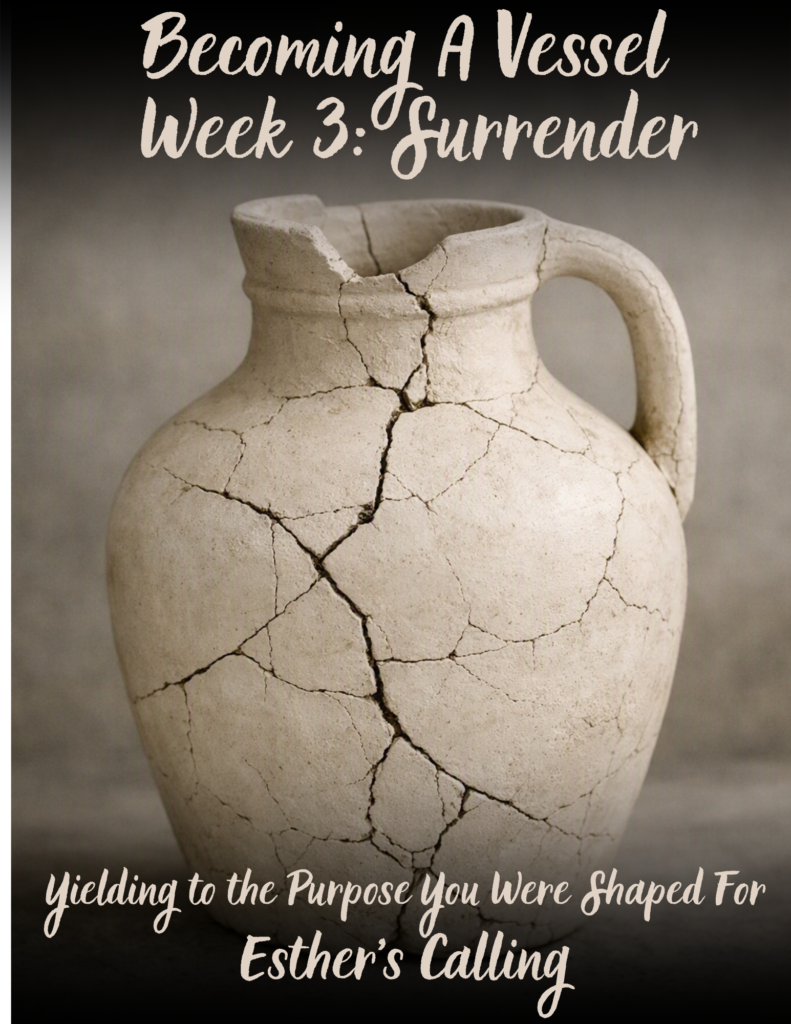
Becoming a Vessel
Week: 3 Surrender
Yielding to the Purpose You Were
Shaped For
Esther’s Surrender
The Book of Esther
We have been on a beautiful journey of Becoming a Vessel — a woman formed by God to carry His Living Water.
- Week 1: Cleansing — God washed the vessel, removing what could not remain.
- Week 2: Shaping — God placed His hands on the clay, forming it through pressure, preparation, and process.
Now we arrive at Week 3: Surrender — the moment the vessel yields fully to the Potter’s purpose. Surrender is not weakness. Surrender is not passivity. Surrender is not giving up. Surrender is yielding to the calling God shaped you for. And no one models this more powerfully than Esther.
Esther’s story didn’t begin with a crown. It began with shaping — long, quiet, hidden shaping. She was taken from her home, placed in a palace she didn’t choose, and prepared for a year through the symbolism of myrrh, perfumes, instruction, and waiting. God was forming her long before she understood why.
When she finally stood before King Xerxes, something remarkable happened. She found favor with everyone — the attendants, the overseer, the palace staff, and even the king himself. Scripture says the king loved her more than all the other women, and he placed the royal crown on her head. Esther became queen.
And for a while… life settled. Five years passed.
Esther lived in the palace, fulfilling her role, carrying herself with grace, and honoring her position. She likely believed this was her calling — to be queen, to serve the king, to represent her people quietly. She even saved the king’s life once, when Mordecai uncovered a plot to assassinate him. Esther reported it, and the conspirators were executed. It must have felt like confirmation: This is why I’m here. This is my purpose. But that was only shaping. Preparation. Positioning. Her true calling had not yet been revealed.
Then the unthinkable happened. She had yielded to the shaping, stepped into her new life in obedience, but now was the true test of Surrender. A decree went out — all Jews were to be destroyed. Her people. Her family. Her identity. Mordecai sent word to Esther, urging her to go to the king and plead for mercy.
Fear washed over her.
She remembered what happened to the last queen, Vashti, who was removed for disobedience. She knew the law: no one approached the king without being summoned. Doing so meant death. And it had been thirty days since the king had called for her — a sign she was not currently in his favor. To go to the king was to risk her life. And there was another fear — one she had carried silently for years. Esther had kept her Jewish identity hidden. No one in the palace knew. To plead for her people, she would have to reveal her secret. She would have to expose who she truly was.
Her crown could not protect her. Her position could not guarantee safety. Her silence could not save her people.
Mordecai’s words reached her like a divine echo:
“Who knows whether you have come to the kingdom for such a time as this?”
Suddenly everything made sense — the shaping, the favor, the crown, the palace, the five years of settling, even the moment she saved the king’s life. None of it was her calling. All of it was preparation. Esther took a breath and surrendered. Not the soft kind of surrender that whispers yes in comfort, but the fierce kind that chooses obedience even when it costs everything. She told Mordecai to gather the Jews and fast. She and her attendants fasted too. And then she spoke the words that revealed her heart:
“I will go to the king… and if I perish, I perish.”
This was surrender.
She walked into the throne room, risking death — and the king extended his scepter. Favor met obedience. Courage met calling. Her surrender opened the door for deliverance. But her obedience did more than save her people It defeated the enemy who threatened them. Haman — the man who plotted their destruction — was exposed. The gallows he built for Mordecai became the gallows he and his sons were hung upon. The enemy was not only stopped; he was overturned. And Mordecai, the man Haman hated most, was elevated to second in command over the entire kingdom.
Esther’s surrender didn’t just save lives. It shifted power. It reversed evil. It elevated righteousness. It fulfilled her calling.
Through Esther’s Surrender, she became the vessel God had shaped her to be.
WHAT WE LEARN FROM ESTHER’S SURRENDER
1. Surrender is stepping into the purpose God shaped you for
Her shaping prepared her for this moment. Your shaping is preparing you too.
2. Surrender requires courage
Esther faced death. Surrender often requires confronting fear and uncertainty.
3. Surrender is costly
She surrendered her safety, comfort, and future. Surrender always costs something — but it produces something greater.
4. Surrender activates calling
Her story shifted when she surrendered — not when she became queen. Your calling is activated when you yield.
5. Surrender impacts others
Her obedience saved a nation, defeated the enemy, and promoted Mordecai. Your surrender will not just bless you and people you love, but it will bless people you may never meet.
6. Surrender is the vessel’s turning point
A vessel is shaped to be used — but surrender is what makes it available.
CONCLUSION
Let Esther’s story ask you the question she had to face:
What if your placement is not accidental?
What if everything God has shaped in you is for this moment?
What if your calling is waiting on your surrender?
He shaped you For Such A Time As This
Will You Surrender?
I want to, I really want to, God knows my heart. I mean He really knows my heart… And He knows if I mean it when I say I want to surrender. There is a measure of fear that accompanies the decision to surrender. Yes, I have fear… But… I do refuse to stay inside this cave!
Well said , “thank you Lord” ,help us to truly surrender ❤️❤️✔️
Pingback: Thirsty Thursday Bible Study October 8th - thebalmonline.com