
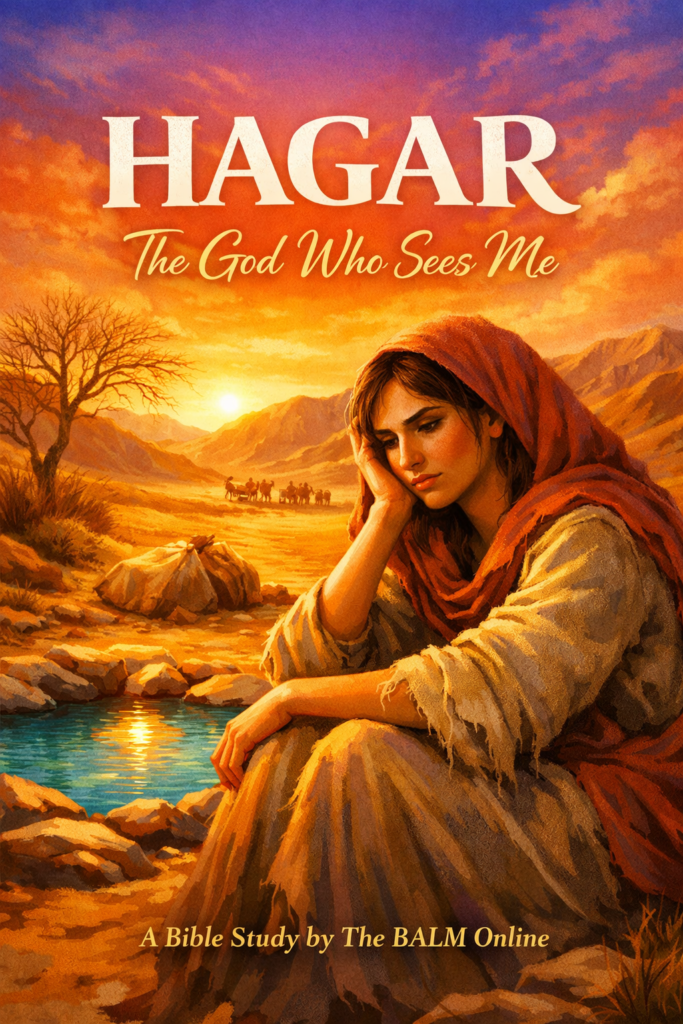
Hagar
The God Who Sees Me
Hagar’s story begins long before she ever runs into the wilderness. It begins with a promise God made to Abram — a promise of descendants as numerous as the stars (Genesis 15:5). But years passed, and Sarai remained barren. Instead of waiting on God’s timing, Abram and Sarai grew impatient. They believed God’s promise, but they didn’t trust His pace. So they decided to “help” God fulfill His word.
“Now Sarai, Abram’s wife, had borne him no children… so she said to Abram, ‘The Lord has kept me from having children. Go, sleep with my slave; perhaps I can build a family through her.’” — Genesis 16:1–2
This was not God’s plan — it was their attempt to force God’s promise into their timeline.
Abram agreed, and Hagar — an Egyptian slave with no voice in the matter — was given to Abram. Scripture says:
“…and he slept with Hagar, and she conceived.” — Genesis 16:4
But there’s a detail we often miss: Hagar wasn’t just a surrogate — Abram took her as a wife.
“Sarai… gave her to her husband Abram to be his wife.” — Genesis 16:3
This means Hagar likely expected a shift in status. A wife. Carrying the patriarch’s child. No longer just a servant. Surely she would now be treated with dignity.
But instead of honor, she received hostility.
When Hagar became pregnant, Sarai’s unresolved pain and insecurity rose to the surface. Sarai blamed Abram, then turned her anger toward Hagar. Scripture says:
“Then Sarai mistreated Hagar; so she fled from her.” — Genesis 16:6
Hagar wasn’t mistreated because she did something wrong. She was mistreated because Sarai felt guilty, jealous, and out of control. Hagar became the target of Sarai’s internal turmoil.
So Hagar ran — pregnant, alone, and heartbroken — into the wilderness.
And this is where God steps in.
“The angel of the Lord found Hagar near a spring in the desert.” — Genesis 16:7
God found her. God saw her. God called her by name — something Sarai never did.
He told her:
“You shall name him Ishmael, for the Lord has heard of your misery.” — Genesis 16:11
In response, Hagar became the first person in Scripture to give God a name:
“You are the God who sees me.” — Genesis 16:13
Years later, after Isaac was born, Hagar was sent away again — this time with her teenage son. Wandering in the desert of Beersheba, her water ran out. Certain her son would die, she placed him under a bush and walked away, unable to watch.
But heaven heard.
“God heard the boy crying, and the angel of God called to Hagar from heaven…” — Genesis 21:17
God opened her eyes to a well of water that had been there all along. He promised Ishmael would become a great nation. And Scripture concludes:
“God was with the boy as he grew up.” — Genesis 21:20
Hagar’s story is one of injustice, rejection, survival, and divine encounter. She is the woman people used, overlooked, and pushed aside — but the woman God saw, pursued, and protected.
Lessons we Learn from Hagar’s Story
1. When we try to “help” God, we create pain God never intended
Abram and Sarai believed God’s promise — but they didn’t trust His timing. Their impatience pushed them into a plan that hurt everyone involved, especially Hagar. When we rush God, we often create situations that wound us and others. But even in the mess we make, God is still merciful.
2. God sees the woman who is used, overlooked, or mistreated
Hagar didn’t volunteer for this role. She was pulled into someone else’s plan, used for someone else’s solution, and blamed for someone else’s guilt. Yet God sought her out. He didn’t go to Abram. He didn’t go to Sarai. He went to the woman everyone else ignored.
“The angel of the Lord found Hagar…” — Genesis 16:7
God sees the woman who feels unseen.
3. God restores dignity where people strip it away
Sarai never called Hagar by name — only “my slave.” But God addressed her personally:
“Hagar, slave of Sarai…” — Genesis 16:8
He spoke her name. He acknowledged her story. He restored her identity.
When people reduce you to a role, a mistake, or a label, God calls you by your name.
4. Other people’s guilt can lead to your mistreatment — but God still defends you
Hagar wasn’t mistreated because she was wrong. She was mistreated because Sarai felt guilty, jealous, and insecure. Hagar became the target of Sarai’s internal struggle.
God does not overlook injustice — even when it comes from people who “should know better.” He steps in. He sees. He responds.
When we are mistreated, hurt, abused the problem lies in the person mistreating, hurting, or abusing,
5. God meets you in the wilderness you didn’t choose
Hagar didn’t choose the desert. She didn’t choose rejection. She didn’t choose to be cast out.
But the wilderness became the place where God revealed Himself most clearly.
Your wilderness is not a sign of abandonment — it’s often the place of encounter.
6. God hears the cries you can’t even pray out loud
When Hagar placed Ishmael under a bush and walked away, she couldn’t even form words. But God heard.
“God heard the boy crying…” — Genesis 21:17
He hears the cries of your heart — even the ones you never speak.
7. God opens your eyes to provision that was there all along
The well wasn’t new. It didn’t suddenly appear. God simply opened Hagar’s eyes to see what she couldn’t see in her pain.
Sometimes the miracle is already in your desert — you just need God to reveal it.
8. Your story doesn’t end with rejection — God writes a new chapter
Hagar’s story didn’t end with being cast out. It ended with God’s presence, God’s promise, and God’s provision.
“God was with the boy as he grew up.” — Genesis 21:20
Your rejection is not your ending. Your wilderness is not your final chapter. God is still writing.
Conclusion
Hagar’s story reminds us that God is not distant, distracted, or disinterested. He is the God who steps into deserts, calls women by name, and reveals purpose in the very places they thought would break them. He sees the woman who feels invisible. He hears the woman who feels unheard. He strengthens the woman who feels exhausted. And He guides the woman who feels lost. You may not have chosen your wilderness, but God has chosen to meet you there. And when He calls your name, may you lift your eyes, open your heart, and see the God who has been seeing you all along.
Lift your eyes in the wilderness — the God who sees you has already made a way.
He is the God Who SEES You!
Great story. I loved it. Have actually felt some of what she went through. Reminds me of the song by Nicole Mullen “The God who sees”.