
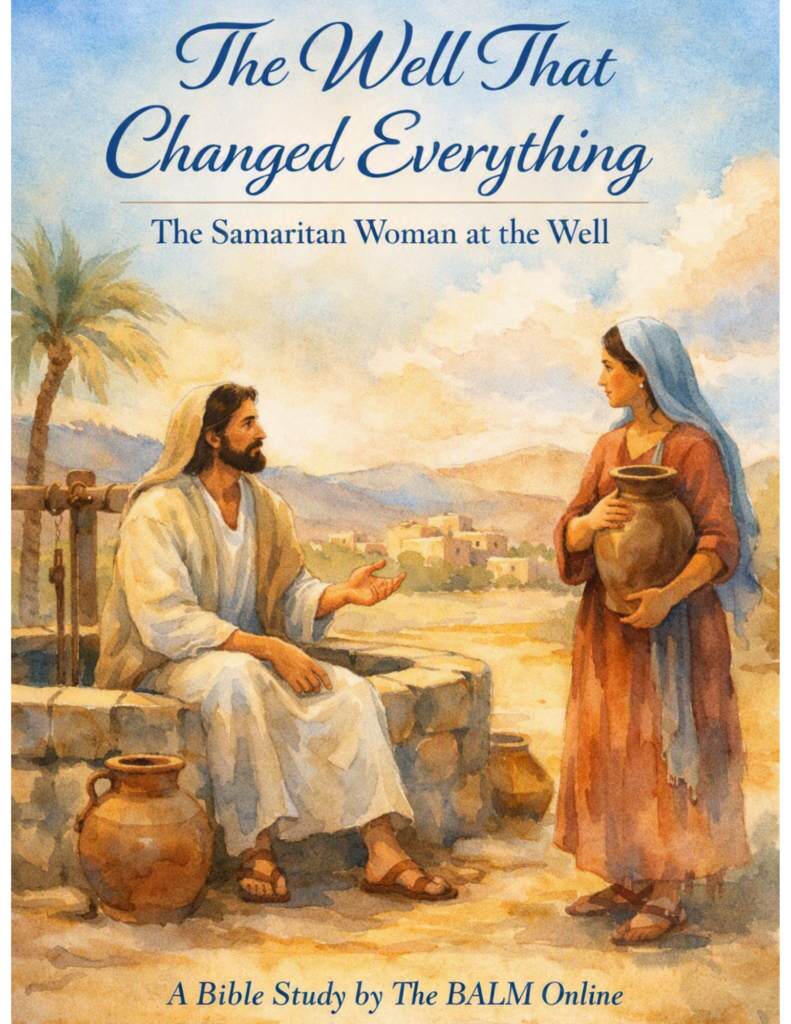
The Well That Changed Everything
The Samaritan Woman at the Well
John Chapter 4
The last few weeks we have walked beside many women whose lives were transformed at wells and watersides. Rebekah found her future at a well. Hagar discovered the God who sees her at a spring. Miriam witnessed deliverance at a river. Rachel encountered destiny at a well. Each story revealed something powerful — but this one changes everything for everyone.
Because at Jacob’s well in John 4, a woman with a complicated past meets the Messiah Himself. Not a prophet. Not a sign. Not a hint. Jesus openly reveals His identity — for the first time — to her.
This well becomes the turning point not just for her life, but for her entire village, and symbolically, for the world. It is the well where Living Water is offered, where shame is shattered, where worship is redefined, and where the gospel begins to ripple outward.
This is the well that changed everything.
The sun was high over Samaria, the kind of heat that presses down on the shoulders and dries the throat. Jesus and His disciples had been traveling, and Scripture says He “must needs go through Samaria” (John 4:4). Jews normally avoided Samaria, but Jesus was not avoiding anything — He was aiming for a divine appointment. He arrived at Jacob’s well, a historic landmark where generations had drawn water. Tired from His journey, He sat down. The disciples went into town to buy food, leaving Him alone.
Then she came.
A Samaritan woman, arriving at noon — the hottest part of the day. Women usually drew water in the cool morning hours, but she came when no one else would be there. Her past had made her an outcast, her reputation whispered about, her presence avoided. She carried not only her water jar, but the weight of her story. Jesus spoke first: “Give me a drink” (John 4:7). She froze. A Jewish man speaking to a Samaritan woman? It broke every cultural rule. “How is it that you, a Jew, ask me, a Samaritan woman, for a drink?” (John 4:9). Jesus answered with something deeper: “If you knew the gift of God… you would have asked Him, and He would have given you living water” (John 4:10).
Living water. Flowing water. Water that never runs dry.
She looked at Him, puzzled. The well was deep. He had no bucket. “Sir, give me this water,” she said, “so I won’t thirst again” (John 4:15). Then Jesus touched the place she hid most carefully: “Go call your husband.” “I have no husband.” “You’re right,” He said gently. “You’ve had five, and the man you’re with now is not your husband” (John 4:16–18). He didn’t expose her to shame — He exposed her to truth. She realized He was no ordinary man. “Sir, I perceive you are a prophet,” she said. “Our fathers worshiped on this mountain, but you Jews say Jerusalem is the place to worship.” Jesus replied with words that would echo through eternity: “Woman, believe me, the hour is coming when you will worship the Father neither on this mountain nor in Jerusalem. The true worshipers will worship the Father in spirit and in truth, for the Father seeks such to worship Him” (John 4:21–23).
In that moment, He revealed that worship was no longer about a location — it was about a relationship. The temple would no longer be the meeting place; He Himself was the meeting place. God was no longer waiting for us to come to Him — He had come to us.
The woman said, “I know that Messiah is coming.” Jesus answered, “I who speak to you am He.”
The first person to hear those words — I am the Messiah — was a Samaritan woman with a broken past.
She dropped her water jar, the symbol of her old life, and ran into town shouting, “Come see a man who told me everything I ever did!” The people listened. They followed her back to the well. They met Jesus. And Scripture says, “Many believed because of her testimony.” The outcast became the messenger. The avoided woman became the evangelist. The well became the birthplace of worship and revival.
This is the well that changed everything — where God came to meet us, not in a temple or on a mountain, but in the middle of our ordinary lives.
The Symbolism of This Well
Jesus “Must Needs Go” to This Well
He didn’t wander into Samaria by accident. He needed to go — because grace was on a mission. This well was not just a meeting point; it was a divine appointment. Jesus crossed cultural, racial, and moral boundaries to reach one woman whose heart was ready for truth.
From Mountain and Temple to Spirit and Truth
When the woman spoke of worship — “Our fathers worshiped on this mountain, and you Jews say Jerusalem is the place” — she was naming the divide that had separated people for centuries. Worship had been tied to geography, ritual, and tradition. But Jesus changed everything. He said, “The hour is coming when you will worship the Father neither on this mountain nor in Jerusalem… the true worshipers will worship the Father in spirit and in truth.” In that moment, He declared that God no longer waits for us to come to Him in a temple — He comes to us. The well became the new sanctuary. The conversation became the new altar. The heart became the new holy place.
The First Open Declaration: “I Am the Messiah”
Jesus chose this woman — not a priest, not a scholar — to hear His full identity. It was a revelation meant to show that grace is for everyone, not just the religious elite. The well becomes a symbol of unrestricted access to God’s presence.
The Meaning of “Never Thirst Again”
Jesus wasn’t promising freedom from physical thirst; He was offering freedom from spiritual emptiness. We still thirst — but now we know where to go. The Living Water is not a drink; it’s a relationship. It’s the continual flow of grace, truth, and renewal that satisfies the soul.
The Well as a Picture of the Church
The Samaritan woman represents the church — once broken, now restored; once excluded, now chosen. She met Jesus at the well, received Living Water, and immediately became a messenger. That’s the pattern of redemption: encounter → transformation → testimony.
The church is not a building or a mountain; it’s a people who have met Jesus and carry His Living Water to others.
What We Learn from the Woman at the Well
1. Jesus Comes to Us Before We Come to Him
The woman thought worship required a mountain or a temple. Jesus showed her — and us — that God is not waiting in a building. He meets us in our ordinary routines, our broken places, our hidden hours. The well teaches us that grace travels.
2. Your Past Does Not Disqualify You From God’s Presence
She came at noon to avoid people. Jesus came at noon to find her. Her story shows that the parts of our lives we hide are the very places Jesus wants to heal.
3. True Worship Is About Spirit and Truth, Not Location
Worship is no longer tied to a mountain, temple, denomination, or ritual. It is tied to truth in the heart and the Spirit’s presence. This woman learned that worship is not about where you stand — but who you stand before.
4. Jesus Reveals Himself to the Humble and the Hungry
She wasn’t a religious leader. She wasn’t a respected woman. She wasn’t even part of the “chosen” people. Yet she received the first open revelation of Jesus as Messiah. God often reveals Himself most clearly to those who are thirsty.
5. Living Water Satisfies What Life Cannot
She had tried relationships, routine, and religion — none satisfied. Jesus offered water that fills the soul, not the jar. We still thirst, but now we know where to go. Living Water is continual renewal, not a one‑time drink.
6. Transformation Begins With Truth, Not Shame
Jesus named her reality without condemning her. Truth opened the door to healing. Her story teaches us that Jesus exposes wounds only to restore them.
7. Your Testimony Can Change a Village
She left her jar — her old identity — and ran to tell others. Her testimony brought many to Jesus. You don’t need a platform; you need a story. And everyone who meets Jesus has one.
8. God Uses the People Others Overlook
She was avoided, dismissed, and judged. Yet she became the first evangelist in Samaria. God delights in using unlikely people to carry unstoppable truth.
Conclusion:
The Samaritan woman came to the well carrying a jar, a routine, and a reputation. She expected nothing more than another lonely trip in the heat of the day. But Jesus was already there — waiting, intentional, purposeful. He met her in a place she didn’t expect, spoke truth she didn’t anticipate, and offered a gift she didn’t know existed. In one conversation, He dismantled centuries of division, redefined worship, revealed His identity, and restored a woman who had been hiding in plain sight.
This is the well that changed everything.
It changed how we worship — no longer on a mountain or in a temple, but in spirit and truth. It changed how we see God — not distant, but present; not waiting, but pursuing. It changed how we see ourselves — not rejected, but redeemed; not overlooked, but chosen. It changed how we see our purpose — not silent, but sent. The woman left her jar because she found something better. She left her shame because she found Someone greater. She left her isolation because she found a mission.
And now the call comes to us.
- Come to the well. Bring your thirst, your questions, your wounds, your story.
- Receive the Living Water. Let Jesus fill the places life has drained.
- Worship in spirit and truth. Not in ritual, not in location, but in relationship.
- Drop your jar. Release the old identity, the old patterns, the old shame.
- Run and tell someone. Your testimony carries Living Water to thirsty people.
The Samaritan woman’s story didn’t end at the well — it began there. And yours can too.
Amen! Thankful to have such a caring Lord. One who cares to meet us, where we are, in the right now. What a blessing he is!! Such a good bible study!!
The Samaritan woman is just like us we all have an God does show us daily but if we not truly walking that walk then we really won’t see it. I love this story is because God can show thing that like Bible times that she didn’t know he do an he still show us that he do anything if we truly trusting in God an truly following him. Thank you for sharing this Bible study with me