
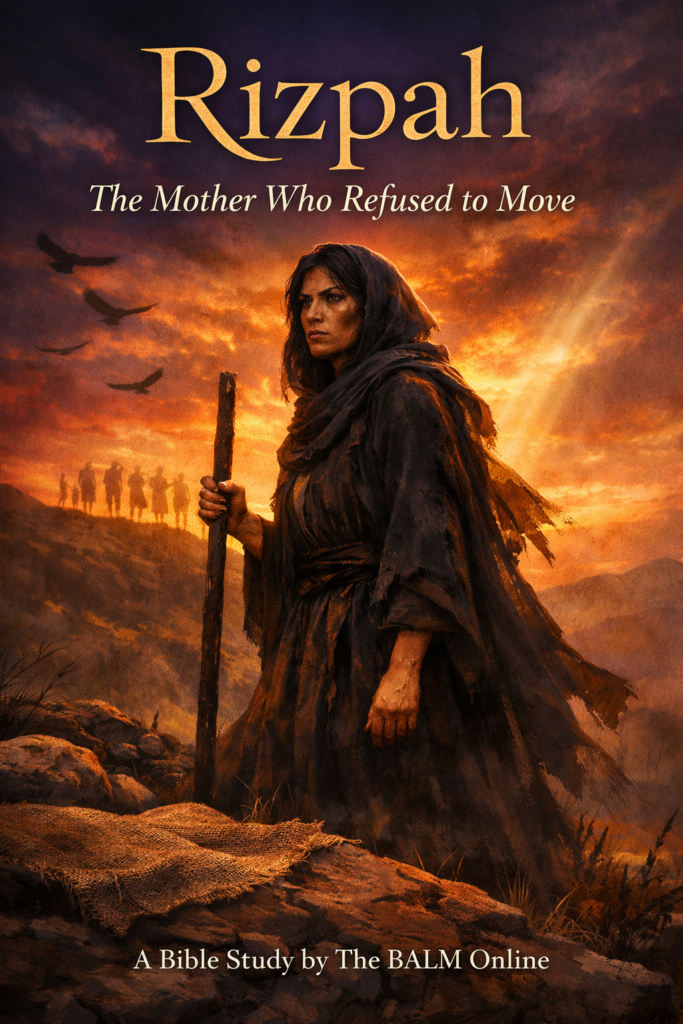
Rizpah
The Mother Who Refused to Move
2 Samuel 21:1–14
The famine had stretched on for three long years. The land was dry, the people weary, and King David sought the Lord for answers. God revealed that the famine was a consequence of Saul’s bloodguilt — his violent, unjust attempt to annihilate the Gibeonites, a people Israel had sworn to protect generations earlier. Justice had been ignored, and the land groaned under the weight of it. To make restitution, David asked the Gibeonites what they required. They demanded something painful: the execution of seven male descendants of Saul. It was a dark moment in Israel’s history — a collision of justice, consequence, and generational sin. Among the men chosen were Rizpah’s two sons, Armoni and Mephibosheth. Rizpah was a concubine of Saul, a woman with little power, little voice, and no ability to stop what was coming.
The executions took place at the beginning of the barley harvest. The bodies of the seven men were hung on a hill in Gibeah — exposed, dishonored, left vulnerable to the scorching sun by day and the predators by night. It was a scene meant to satisfy justice, but it left a mother shattered.
Rizpah could not save her sons from death, but she refused to let them be forgotten.
She gathered sackcloth — rough, scratchy, the fabric of mourning — and spread it on a rock near the bodies. And there she stayed. Day after day. Night after night. Week after week. Scripture says she remained there “from the beginning of harvest until the rains poured down from heaven” (2 Samuel 21:10). That means months. Under the burning heat, she kept watch. When vultures circled overhead, she waved them away. When jackals crept close in the darkness, she drove them back. When exhaustion pressed on her bones, she stayed. When grief threatened to crush her, she stood her ground. Rizpah’s vigil was not loud. She didn’t shout. She didn’t demand. She didn’t storm the palace. Her protest was silent, but it thundered across Israel.
People began to talk. Who was this woman? Why was she still there? Why had no one buried the sons of Saul? Why was justice so incomplete, so cruel, so careless? Word reached King David. And when he heard what Rizpah had done — how she had guarded the bodies of her sons with a mother’s fierce love and a warrior’s endurance — something broke open in him. Her silent vigil awakened a king’s conscience. David gathered the bones of Saul and Jonathan, which had been taken by the Philistines years earlier. He retrieved the bodies of the seven men, including Rizpah’s sons. And he gave them all a proper burial — dignity restored, honor returned, justice completed.
Only after Rizpah’s act of devotion, Scripture says, “God answered prayer on behalf of the land.” Her grief moved a king. Her endurance healed a nation. Her love opened the heavens.
Rizpah was a woman with no status, no power, and no voice in the political decisions that destroyed her family. Yet her courage — her refusal to leave her sons in dishonor — became the turning point in Israel’s story. She stood on a lonely hillside, fighting off birds and beasts, but in the unseen realm she was fighting for justice, dignity, and remembrance. She was a mother who would not move. A woman who turned mourning into a movement. A quiet force who changed the heart of a king. Rizpah’s story is a testament to the power of steadfast love — the kind that refuses to let death have the last word,
✨ Lessons from Rizpah’s Story
Rizpah’s story is not loud, but it is unforgettable. It is the story of a woman who had every reason to collapse under the weight of grief, injustice, and powerlessness — yet she stood. She stood when the system failed her. She stood when leadership overlooked her. She stood when her sons were taken from her and left exposed on a hill. She stood when no one expected her to. She stood when no one else would.
Her vigil was not a moment; it was a movement. A movement born from love, fueled by grief, and sustained by a strength that only God could give. She didn’t have a title. She didn’t have influence. She didn’t have a platform. But she had presence — and presence can be prophetic.
Rizpah teaches us that faithfulness is not always glamorous. Sometimes it looks like staying in a hard place longer than you ever imagined. Sometimes it looks like fighting off the vultures of despair, the jackals of fear, the whispers of “give up,” and the shadows of “it’s too late.” Sometimes faithfulness looks like standing guard over something that seems dead — a dream, a relationship, a calling, a promise — because you believe God is not finished yet.
She also teaches us that grief can be holy. Her mourning was not passive; it was active. It was a declaration that her sons mattered, that injustice would not be ignored, and that dignity would not be denied. Her grief moved a king. Her endurance shifted a nation. Her love opened the heavens.
Rizpah reminds us that you don’t need a microphone to make a difference. You don’t need a title to change a story. You don’t need a position to influence a king. Sometimes the most powerful sermons are preached without words — through endurance, integrity, and unwavering presence.
And perhaps the most profound lesson is this: God sees the woman who refuses to move. The woman who stays on her post. The woman who keeps showing up. The woman who guards what God gave her. The woman who fights off the things that come to devour her hope. The woman who stands in the gap even when her heart is breaking.
Rizpah’s story is a reminder that heaven pays attention to the woman who stays. The woman who endures. The woman who loves fiercely. The woman who refuses to let death, injustice, or silence have the final word.
🔥 Conclusion
Stand your ground.
Stand in prayer.
Stand in purpose.
Stand in love.
Stand in the place God has assigned you
Even when it’s hard, even when it’s lonely, even when it feels like no one notices. Your endurance may awaken someone’s conscience.
Your faithfulness may shift a story.
Your presence may open the heavens.
Your stand may change a generation.
Like Rizpah, refuse to move until God moves.
I do know this, when wrapped up in grief, it truly takes God to move you.