
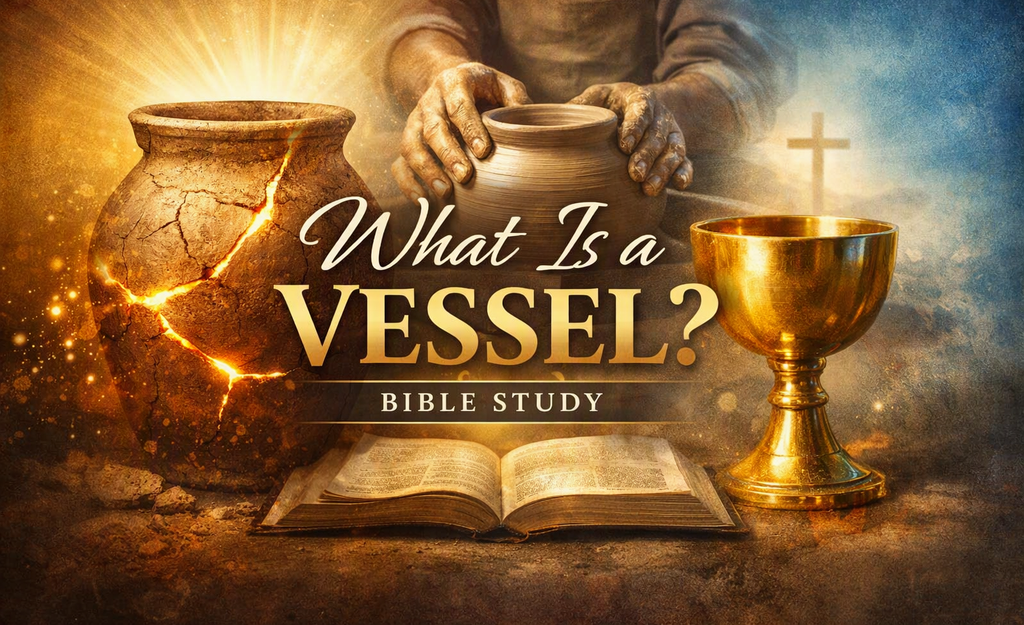
What IS A Vessel?
After completing our 8‑week journey through Becoming a Vessel, we felt it was important to pause and explore the biblical context behind the vessel metaphor itself. This study will not follow a single Bible story. Instead, it will examine the key Scriptures that define what a spiritual vessel is, how God uses this imagery throughout His Word, and why understanding the vessel is essential before we explore What’s in Your Vessel.
This study is meant to deepen your understanding, strengthen your foundation, and prepare your heart for what God desires to pour into you next.
What Scripture Teaches About Spiritual Vessels
1. 2 Timothy 2:20–21 — Vessels of Honor and Dishonor
“But in a great house there are not only vessels of gold and of silver, but also of wood and of earth; and some to honour, and some to dishonour. If a man therefore purge himself from these, he shall be a vessel unto honour, sanctified, and meet for the master’s use, and prepared unto every good work.”
Context:
The Apostle Paul is writing a pastoral letter to his spiritual son, Timothy. The church is facing false teaching, confusion, and moral compromise. Paul uses the imagery of a “great house” filled with different kinds of vessels — some honorable, some dishonorable — to teach Timothy the importance of remaining faithful to the Word of God.
Paul’s message is clear:
A vessel’s honor is determined by its purity and its obedience, not its outward appearance or position.
Those who cleanse themselves from false teaching and ungodly behavior become vessels useful to the Master.
This passage teaches us that a spiritual vessel must be clean, consecrated, and committed to truth.
2. Jeremiah 18:1–6 — The Potter and the Clay
“The word which came to Jeremiah from the LORD, saying, Arise, and go down to the potter’s house, and there I will cause thee to hear my words. Then I went down to the potter’s house, and, behold, he wrought a work on the wheels. And the vessel that he made of clay was marred in the hand of the potter: so he made it again another vessel, as seemed good to the potter to make it. Then the word of the LORD came to me, saying, O house of Israel, cannot I do with you as this potter? saith the LORD. Behold, as the clay is in the potter’s hand, so are ye in mine hand, O house of Israel.”
Context:
God sends Jeremiah to the potter’s house to give him a prophetic picture of Israel’s spiritual condition. The potter is shaping a vessel, but it becomes marred in his hands. Instead of discarding it, the potter reshapes it into another vessel as he sees fit.
God explains:
“Just as the clay is in the potter’s hands, so are you in My hands.”
This passage reveals that a spiritual vessel is formed by God, not by personal effort.
Even when we become cracked, flawed, or broken, God does not throw us away — He reshapes us according to His will.
3. 2 Corinthians 4:7 — Treasure in Jars of Clay
“But we have this treasure in earthen vessels, that the excellency of the power may be of God, and not of us.”
Context:
Paul is writing to the church in Corinth about the challenges of ministry, suffering, and human weakness. He reminds them that they are “jars of clay” — fragile, ordinary, imperfect — yet God has placed His treasure inside them.
The treasure is the light of Christ, the power of the Holy Spirit, and the glory of the gospel.
This passage teaches that the vessel itself is not the focus — the treasure inside is what gives it value.
Our weakness highlights God’s strength.
4. Acts 9:15 — A Chosen Vessel
“But the Lord said unto him, Go thy way: for he is a chosen vessel unto me, to bear my name before the Gentiles, and kings, and the children of Israel:”
Context:
Saul (later Paul) has just encountered Jesus on the road to Damascus. While Saul is blinded and waiting, God speaks to Ananias and tells him that Saul is His“chosen wessel” to carry His name to the Gentiles.
This passage teaches that every vessel has a divine assignment.
God chooses vessels not based on their past, but based on His purpose.
5. 1 Thessalonians 4:4 — Controlling Your Vessel
“That every one of you should know how to possess his vessel in sanctification and honour;”
Context:
Paul is instructing the Thessalonian believers on how to live holy lives in a culture filled with immorality. He tells them each person must “control their own vessel in holiness and honor.”
Here, “vessel” refers to the body and life of the believer.
This passage teaches that being a vessel includes self‑discipline, purity, and daily obedience.
A vessel must be kept clean to remain useful.
6. Psalm 34:18 & Isaiah 61:1 — Broken Vessels Restored
“The LORD is nigh unto them that are of a broken heart; and saveth such as be of a contrite spirit.” Psalm 34:18
“The Spirit of the Lord God is upon me; because the Lord hath anointed me to preach good tidings unto the meek; he hath sent me to bind up the brokenhearted, to proclaim liberty to the captives, and the opening of the prison to them that are bound.” Isaiah 61:1
Context:
Both passages speak of God’s heart toward the broken, wounded, and crushed.
Psalm 34:18 declares that God is near to the brokenhearted.
Isaiah 61:1 prophesies that the Messiah will bind up the brokenhearted and restore what is damaged.
These passages teach that even when a vessel is cracked or shattered, God is able to heal, restore, and refill it.
Brokenness does not disqualify a vessel — it prepares it for deeper use.
The Scriptures above perfectly align with the six steps we studied in our last series Becoming A Vessel that walked us through the process of becoming a vessel.
Today’s study shows the biblical foundation of that process.
Now that we understand what a vessel is, we are ready to explore what God desires to place inside one.
Our new series starting next week is………
What’s in your vessel?
What We Learn From These Scriptures
- A vessel is formed by God, not self‑made.
- A vessel must be cleansed to be used.
- A vessel carries treasure, not emptiness.
- A vessel has a purpose and assignment.
- A vessel must be kept pure.
- A vessel can be restored when broken.
- A vessel’s value comes from what God places inside.
- Every believer is called to be a vessel of honor.
Conclusion
As we conclude this study, take time this week to reflect on what kind of vessel you are right now.
Are you allowing God to shape you?
Are you keeping your vessel pure?
Are you ready to be filled?
Are you willing to be poured out?
We invite you to join us next week as we begin our new series:
A powerful exploration of the spiritual contents God desires to place within you.
A vessel is only as powerful as what it carries
Fill my cup Lord…I lift it up Lord…fill it up Lord and make me whole!